
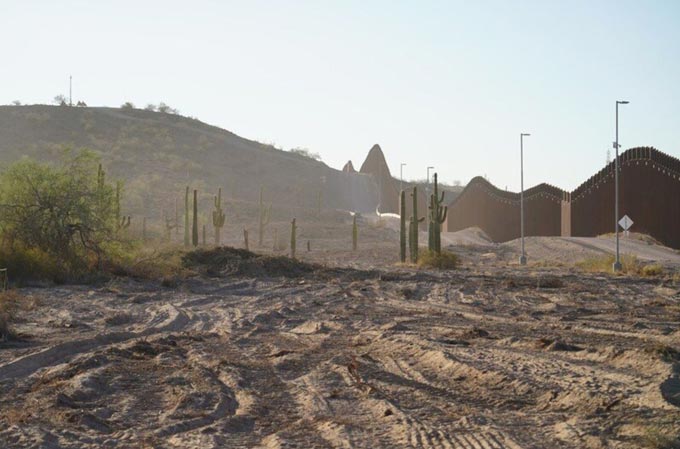
Protected desert land bulldozed for second border wall in Organ Pipe Cactus National Monument, Aug. 17 2026. Credit: Russ McSpadden, Center for Biological Diversity.
Federal contractors are clearing protected Sonoran Desert habitat in a national park after the administration waived laws designed to protect natural resources and cultural sites, sidestepping extensive review typically required before large-scale project construction.
August 20, 2026 - Ajo, Arizona—Arizonans and park advocates are raising the alarm as federal contractors have begun construction of a second border wall through Organ Pipe Cactus National Monument this week. Construction of the existing 30-foot border wall began in 2019 and now currently extends across the full length of the park’s border.
Related: Center for Biological Diversity Reports Protected Desert Bulldozed for Second Border Wall in Arizona’s Organ Pipe Cactus National Monument
Images and video from the Center for Biological Diversity reported by the Arizona Daily Star show desert habitat cleared of plant life by bulldozers, with heavy equipment causing damage to the national park site and surrounding public lands.
Earlier this month, the National Park Service announced road closures at the park near the area now impacted, likely to protect visitor safety. The road closures have complicated access to Quitobaquito Springs, an important cultural site for local Indigenous communities who have stewarded this landscape since time immemorial. The documented damage to the park was captured by a hiker who reached the area on foot.
There are two national park sites that sit along the U.S.-Mexico border in Arizona—Organ Pipe Cactus National Monument and Coronado National Memorial—and both are being severely impacted by additional border wall construction. The National Parks Conservation Association has long opposed these projects due to the devastation they cause to these remote and rugged park sites.
At Coronado National Memorial, one of the last wildlife corridors on the Arizona-Mexico border, simultaneous construction of both a primary and secondary border wall is already underway and moving rapidly through the park and its adjacent landscape. A portion of the historic Arizona Trail here has recently been closed to public access.
At Organ Pipe Cactus National Monument, the environmental and cultural destruction from the first wall construction along the monument’s southern boundary has already been documented by the U.S. Government Accountability Office, including damage to sensitive ecosystems, wildlife migration routes, water access, and cultural sites.
Similar border construction work through Big Bend National Park in Texas was temporarily paused on Monday after a wave of public backlash.
Statement from Sanober Mirza, Arizona Senior Program Manager for the National Parks Conservation Association
“This is a reckless assault on one of our most extraordinary national parks. The administration is tearing through fragile desert habitat and sacred cultural sites, all to build a wall that duplicates the one already standing.
“Damage from the first wall, built years ago, has already devastated wildlife migration routes, water access, and cultural sites in a national park that is unlike any other. The environmental and cultural impacts weren’t considered then, and they aren’t being considered now.
“A second wall is adding insult to injury, particularly for the cultural landscapes protected here. Indigenous peoples have lived with, cared for, and depended on this landscape since time immemorial and many sites remain in active use, but are at risk of being destroyed or permanently altered by wall development.
“This is the worst-case scenario for this park. With construction moving ahead, this administration continues to show a brazen disregard for environmental and cultural laws, and for everyone who cares about and enjoys our national parks.”
About the National Parks Conservation Association: Since 1919, the nonpartisan National Parks Conservation Association (NPCA) has been the leading voice in safeguarding our national parks. NPCA and its more than 1.9 million members and supporters work together to protect and preserve our nation’s most iconic and inspirational places for future generations. For more information, visit [www.npca.org](www.npca.org).
Source: National Parks Conservation Association