
“Empathy Gap” Sharply Divides Trump Supporters From Other Americans, 2024 GOP Coalition Fractures
October 20, 2026 - WASHINGTON — The 17th annual American Values Survey, released today by Public Religion 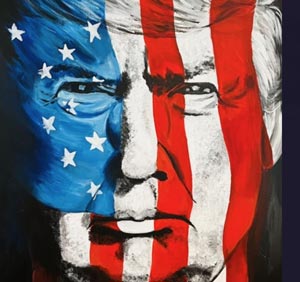 Research Institute (PRRI) in partnership with the Brookings Institution, examines Americans’ attitudes toward President Donald Trump and his administration, as well as immigration, economic inequality, socialism, the MAGA movement, foreign policy, and social trust.
President Trump's Truth Social Avatar
Heading into the midterms, more Americans see Trump as a threat to democracy — and the coalition that powered his 2024 victory is fracturing. Nearly six in ten (58%) Americans now agree that “President Trump is a potentially dangerous dictator whose power should be limited before he destroys American democracy,” up from 52% in March 2025. Today, nearly two-thirds of independents (64%) and Hispanic Americans (64%) agree that Trump is a dangerous dictator whose power should be limited.
The new survey also finds that an “empathy gap,” beliefs about the social importance of empathy, has become a major new political dividing line. While two-thirds of Americans —including 84% of Democrats and 70% of independents — agree that “empathy is a foundational moral value that helps build a healthy society (68%), only 54% of Republicans and 48% of white evangelical Protestants agree. Notably, a majority of white evangelical Protestants (54%) believe the opposite: that “empathy can become dangerous when it leads people away from building a society guided by God’s truth.”
“As Christian nationalist leaders attack the sentiment of empathy, a disturbing ‘empathy gap’ has opened, separating Republicans and white evangelicals from most other Americans,” says PRRI President and Founder Robert P. Jones, Ph.D. “Such orchestrated attacks are typical of violent authoritarian movements and should be disturbing to all who care about the moral foundations of our pluralistic democracy.”
Two-thirds (68%) of Americans say their opinion of Donald Trump has mostly changed for the worse over the last two years, including in communities that had been among his core supporters. Trump’s favorability among Hispanic Protestants has dropped from 51% in 2024 to 31% today, and Hispanic Trump voters are twice as likely as white Trump voters to express regret about their vote choice (22% vs. 11%).
“The coalition that put Donald Trump back in the White House is breaking apart, with 76% of Americans saying the economy is on the wrong track,” explains PRRI CEO Melissa Deckman, Ph.D. “His 2024 gains are clearly not a long-term realignment, as we see Black, Hispanic, and young male voters moving back to Democrats.”
With most Americans saying that the country (71%) and the economy (76%) are going in the wrong direction, Democrats hold a clear enthusiasm advantage ahead of the midterms. Democratic voters are significantly more likely than Republican voters to say they are very excited about voting in November (46% vs. 31%). In the religious landscape, Black Protestants are more likely than white evangelical voters to say they are very excited about voting in the midterms (34% vs. 26%).
Populist economic policies draw broad support, and half of younger Americans say they would be open to adopting some aspects of socialism. Four in ten Americans (41%) agree that capitalism is no longer working for average Americans and the country should consider adopting some aspects of socialism – including nearly half of Americans ages 18-29 (48%). Additionally, Americans are significantly more likely to see the MAGA movement than the Democratic Socialists of America as a serious threat to the country (48% vs. 36%).
As Republicans and white evangelical Protestants have moved sharply toward deportation over the past decade, six in ten Americans (59%) still favor providing a pathway to citizenship for undocumented immigrants. Since 2013, Republican support for a path to citizenship has fallen from 53% to 37%, while support for identifying and deporting all undocumented immigrants has risen from 32% to 50%. Independents have remained mostly supportive (61% support vs. 64% in 2013). White evangelical Protestants have followed a similar path: support for citizenship has dropped from 56% to 44%, and support for deportation has climbed from 30% to 47%.
Confidence in elections remains fragile, however, as Americans divide along partisan lines over election integrity and federal intervention in local voting. Most Republicans (82%) say the biggest problem in U.S. elections is ineligible people casting votes, while most Democrats (80%) say the biggest problem is eligible voters being denied the right to vote. While just 35% of Americans agree that “if there are serious concerns about voter fraud in a local voting location, the president should order federal agents to seize the ballots and take over the vote counting,” this percentage rises to 58% among Republicans, particularly Republicans who view Trump favorably (65%).
Other notable findings:
- Majorities of both Democrats and Republicans say the rising cost of housing and everyday expenses (61%) and electing leaders of good moral character (59%) are critical issues. Among Republicans, concern about electing leaders of good moral character has little impact on favorable views of Donald Trump (Trump favorability is 73% among those saying this is critical; 79% among those who say it is not critical).
- Majorities of Republicans and white evangelical Protestants support detaining undocumented immigrants in internment camps until they can be deported (62% and 53%).
- Large bipartisan majorities say it should be illegal for elected officials to use their office to benefit themselves or their families financially (88%), to draw voting maps for partisan advantage (83%), or to buy or sell individual stocks while in office (80%).
- Just one-third of Americans (36%), but 71% of Republicans, agree that the United States was justified in carrying out military strikes against Iran.
- Nearly two-thirds of Americans (64%) agree the United States provides too much financial and military support to Israel, compared with three in ten (30%) who disagree.
Methodology
The survey was designed and conducted by PRRI. The survey was made possible through the generous support of the Andrew Carnegie Foundation, with additional support from the Ford Foundation, the Glenn Family Foundation, and the Unitarian Universalist Veatch Program at Shelter Rock. The survey was conducted among a representative sample of 5,200 adults (age 18 and up) living in all 50 states in the United States, who are part of Ipsos’s KnowledgePanel, and an additional 339 who were recruited by Ipsos using opt-in survey panels to increase the sample sizes in smaller states. Interviews were conducted online between August 20 and September 7, 2026. The margin of error for the national survey is +/- 1.6 percentage points at the 95% level of confidence, including the design effect for the survey of 1.48.
About PRRI
PRRI is a 501(c)(3) nonprofit, nonpartisan organization dedicated to conducting independent research at the intersection of religion, culture, and politics.
Source: PRRI