


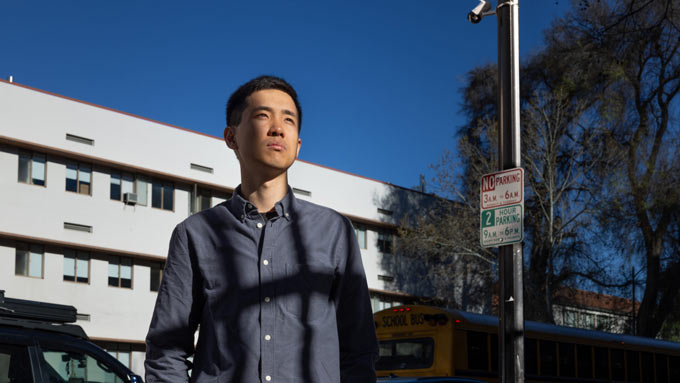
Tony Tan stands near an automated license plate reader camera in San Jose, California. He is suing the city over its use of nearly 500 such cameras.
IJ is a public interest law firm. We represent clients free of charge in cutting-edge litigation defending vital constitutional rights. You can join us by supporting our work here: ij.org/support
April 20, 2026 - SAN JOSE, Calif. - By Dan King - Last week, a group of three San Jose residents teamed up with the Institute for Justice (IJ) to file a federal class action lawsuit against the city of San Jose over its use of hundreds of automated license plate reader (ALPR) cameras. Tony Tan, Scott West, Colin Wolfson and their IJ attorneys argue the city’s use of 474 ALPRs violates the Fourth Amendment to the United States Constitution.
“San Jose’s ALPR surveillance system is one of the largest anywhere,” said IJ Attorney Michael Soyfer, one of the leaders of IJ’s national campaign against ALPR abuse. “Not only does the city have a staggering number of cameras, it lets thousands of government employees across California access all of its data without a warrant. Those government employees search San Jose drivers’ data thousands of times every day with almost no oversight, creating a situation that’s ripe for abuse.”
ALPRs are cameras that photograph every passing vehicle, use artificial intelligence to convert the images into data, and upload the images and data to a database. These cameras can identify the make, type, and color of a car, as well as other distinctive features like bumper stickers, roof racks, and toolboxes. Police can search for a car by entering a full or partial license plate number or filtering to cars with similar features to the car they are trying to find. They can even type in a description of the car or upload an image, and have artificial intelligence pull up pictures of cars that match the description or image. Most law enforcement agencies that operate ALPR networks pool data with other jurisdictions. Some even opt into nationwide databases.
San Jose first entered a pilot program with the ALPR provider Flock Safety in 2021, that involved placing four cameras at a single intersection. Since that time, the number of cameras has grown to 475. San Jose initially held onto all of this data for 365 days, though it recently reduced the retention period to 30 days.
Tony works as a privacy engineer for a tech company. He grew up in China, Japan, and Massachusetts, before moving to Silicon Valley. He is politically active and concerned the cameras could be used to monitor his First Amendment-protected activities, including monitoring ICE enforcement around San Jose. His familiarity with China’s surveillance state made him especially concerned about San Jose’s ALPR system when he began learning about it.
“As an engineer specializing in privacy, I know how important it is to protect people’s data and how even just a few points of location history can reveal profound and sensitive insights about a person’s life,” said Tony. “Having spent time in China, I know what an authoritarian surveillance state looks like, and I worry about the proliferation of similar mass surveillance technologies across the United States. I want to ensure that police state tactics do not become commonplace here.”
Scott is a California native who works for a company that sells auto parts. His father was a longtime sheriff’s deputy in Riverside County. While Scott certainly values law enforcement, he finds the mass surveillance of people’s movements across San Jose overbearing and creepy. Colin is a San Jose native who drives past these cameras daily on his commute and, much like Tony and Scott, finds the city’s mass surveillance unnerving.
In recent months, several local municipalities—including Santa Clara County, Los Altos Hills, and Mountain View—have canceled ALPR contracts over concerns about abuse. Officers have reportedly used the system to run searches on behalf of federal immigration agents, surveil protestors, and even stalk ex-partners. This case is the first to challenge the federal constitutionality of San Jose’s ALPR system.
Through its Plate Privacy Project, IJ is fighting back against the unfettered growth of police surveillance. In October 2024, IJ filed a federal lawsuit against the city of Norfolk, Virginia, over its use of more than 170 ALPRs. That lawsuit is the first civil lawsuit challenging ALPR use to make it past the government’s motion to dismiss. IJ has also helped activists across the country fight against warrantless ALPR use and has worked with lawmakers on reforms.
