


June 1, 2026 - WHO has launched a guide to help countries and organizations scale up psychological self-help interventions, aiming to expand access to evidence-based mental health 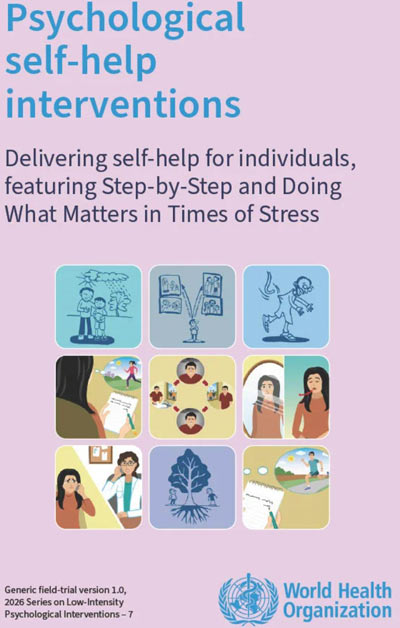 care.
care.
Psychological self-help interventions: delivering self-help for individuals, featuring Step-by-Step and Doing What Matters in Times of Stress provides practical advice on planning, adapting and delivering self-help, with or without support from trained non-specialists. More than one billion people worldwide live with a mental health condition, yet many lack access to effective care. Psychological self-help interventions are one way to help close this gap, offering structured techniques that people can use on their own, supported by minimal human resources. They can be delivered in communities, or remotely at scale.
Evidence shows self-help approaches are effective, particularly for depression and anxiety, and they have already been recommended in WHO guidelines for a range of mental health, brain health and substance use conditions. Their ability to reach large numbers of people remotely makes them especially valuable in low-resource and crisis-affected settings. The new guide draws on extensive work by WHO and partners with populations in various countries.
Practical guidance for implementation
The guide targets programme managers, implementers, supervisors and frontline helpers across health, humanitarian and community settings. It sets out practical steps for establishing both unguided and guided self-help models. Guided self-help involves delivering the self-help intervention with brief regular support either within existing appointments or from a trained and supervised non-specialist helper. The guide explains how to integrate self-help interventions into existing primary health care, community programmes and digital services, and includes tools, scripts and templates to support high-quality implementation.
Implementing WHO self-help interventions
The new guide also provides detailed information on implementing two WHO interventions that have been rigorously tested in randomized controlled trials where they were delivered with 15 minutes of support over five weeks from a trained and supervised non-specialist helper: Step-by-Step, a digital intervention for adults with depression, and Doing What Matters in Times of Stress, a stress management intervention based on acceptance and commitment therapy. Digital versions are already embedded in national services in Lebanon and Thailand, showing how self-help can be delivered safely and effectively at scale.
The new guide adds to WHO’s suite of resources on psychological interventions and is expected to support global efforts to expand access to community-based, evidence-based mental health care.
Related
