


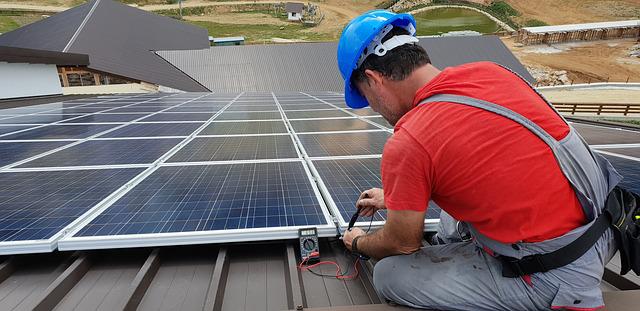
Image by Alex Csiki from Pixabay
June 19, 2026 - SAN FRANCISCO— Health, environmental and community groups filed a formal request on Thursday asking the California Public Utilities Commission to reconsider its denial of a petition seeking to improve energy affordability and public health in the San Joaquin Valley.
“State regulators have ignored the law and effectively abandoned families in one of California’s lowest-income and most polluted regions,” said Roger Lin, an attorney with the Center for Biological Diversity’s Climate Law Institute. “Our reasonable request to the commission is that it correct its decision and relaunch this program to provide affordable clean energy to the thousands of Valley residents who’ve been waiting for more than a decade. Commissioners can’t just turn their backs on the law and these California communities.”
State law requires the California Public Utilities Commission to reopen an affordable clean energy program it closed in 2020 without notice, leaving hundreds of thousands of low-income rural residents without safe, affordable heat and electricity, according to the 2025 petition filed by the Center for Biological Diversity, Central California Asthma Collaborative, the Center on Race, Poverty and the Environment, and Leadership Counsel for Justice and Accountability.
In May the commission denied the groups’ petition.
In 2018 the commission authorized 10 affordable clean energy projects in the San Joaquin Valley but closed the program in 2020 without completing its final phase — evaluating the pilot to see whether it should be replicated in 160 other communities that lack access to fossil-fuel gas and adequate electricity service. Several of these communities were redlined out of utility service in the 1970s so families are still burning wood or using propane to cook, stay warm and heat water.
“The San Joaquin Valley pilots worked. They improved the air quality inside people's homes, lowered energy costs, and gave families in some of California's most underserved communities a real path to affordable, clean energy,” said Sarah Sharpe, deputy executive director with the Central California Asthma Collaborative. “Now the Public Utilities Commission has a chance to do what's right for the Central Valley communities that could benefit. We’re hopeful the commission will take this opportunity to reconsider and finish what was started.”
The San Joaquin Valley is one of the most economically disadvantaged and environmentally burdened areas in the United States. The Valley suffers from some of the worst air quality in the nation and has repeatedly failed to meet federal health standards for ozone and particulate pollution. These conditions contribute to elevated asthma rates, particularly among children, as well as other cardiovascular and respiratory diseases.
California sought to address this with a 2014 law requiring the commission to identify San Joaquin Valley communities that lacked access to adequate utility infrastructure and service. The law was intended to improve regional health, safety and air quality by finding ways to get affordable energy to these places. It became the most ambitious affordable clean energy project in the country.
The commission identified 178 disadvantaged communities that met the program’s criteria, which included roughly 890,000 households. In 2018 it authorized 10 affordable energy pilot projects, giving households access to solar energy, electric appliances and energy-efficiency resources, and hiring community navigators to help people sign up for electricity and utility discount programs. It also created a utility bill savings program that has reduced electricity costs for participants in the pilot but which is due to expire in 2029.
State law required the commission to evaluate the pilot program and decide whether to expand it. Instead commissioners closed the pilot in 2020 without public input.
“I participated in the San Joaquin Valley pilot program and received an electric dryer, air conditioner, and water heater,” said Maria Dolores Diaz, who lives in the Cantua Creek community in Fresno County. “These appliances are indispensable in an area that gets very hot and where energy affordability gets worse every year. I would like for people who were not able to participate in the pilot to have access to these benefits, especially people like me who are elderly and need this help,”
The pilot program was largely successful, demonstrated multiple benefits to people’s health and safety, and provided lessons that could improve the experience for the remaining eligible communities.
The Center for Biological Diversity is a national, nonprofit conservation organization with more than 1.8 million members and online activists dedicated to the protection of endangered species and wild places.
Source: Center for Biological Diversity
