


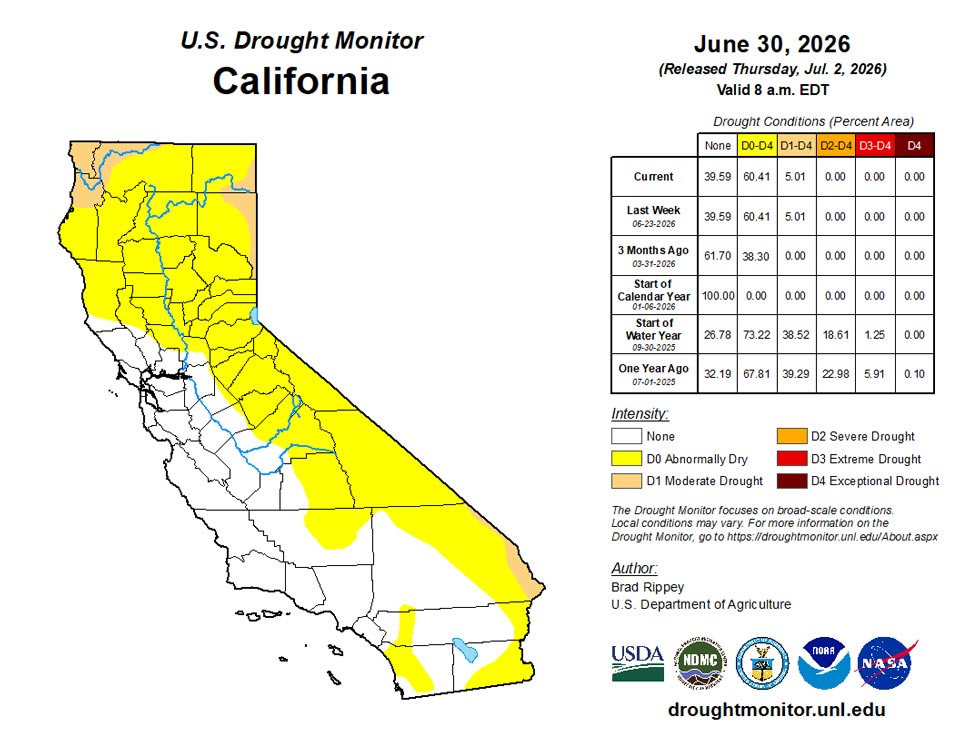
California and National Drought Summary for June 30, 2026
Summary
July 2, 2026 - Active weather delivered heavy showers and locally severe thunderstorms east of the Rockies, with a few exceptions. Some of the heaviest rain, locally 4 to 8 inches or more, fell from portions of the central and southern Plains into the Ohio and Tennessee Valleys, leading to pockets of flash flooding and lowland flooding. At least five flood-related fatalities were reported in Kentucky and Tennessee. Exceptions to the wet pattern included the western Gulf Coast region, parts of the Southeast, and an area stretching from the east-central Plains into the lower Great Lakes region. At the start of the drought-monitoring period, hot, dry weather dominated the West. However, a pattern change soon delivered cooler weather across the western U.S., along with widespread Northwestern precipitation. Wet snow blanketed some high-elevation sites in the northern Rockies. During the transition from hot to cool weather, gusty winds and low humidity levels favored wildfire ignition and rapid expansion, especially in portions of the eastern Great Basin and Four Corners States. At the end of June, more than a dozen active Western wildfires had scorched more than 10,000 acres of vegetation apiece, with the largest being the 94,000-acre Cottonwood Fire near Beaver, Utah. On June 28, three federal firefighters perished in the Knowles Fire, west of Grand Junction, Colorado.
Northeast
Weather conditions were mixed during the drought-monitoring period, with streaks of heavy rain affecting some areas while other places remained mostly dry. Generally, wet weather continued to trim abnormal dryness (D0) and moderate drought (D1) across northern New England. Meanwhile, significant rain mostly bypassed southern New England, leading to status quo or slightly worsening drought. The southern tier of the region, from West Virginia to Delaware and New Jersey, mostly experienced drought improvement, except for a few spots in the northern mid-Atlantic. On June 28, the U.S. Department of Agriculture reported that statewide topsoil moisture in agricultural regions was rated more than one-half very short to short in Maryland (79%), Delaware (76%), Rhode Island (70%), Connecticut (55%), and New Jersey (54%).
Southeast
Like the Northeast, highly variable rainfall totals were observed during the drought-monitoring period. Some areas, such as northern Alabama and northwestern Georgia, were completely dry, while heavy showers soaked northeastern North Carolina and neighboring areas. Worsening drought was largely limited to the coastal plain of South Carolina and southeastern North Carolina, while pockets of drought improvement were noted in several areas, including southeastern Virginia and northern Florida. Florida’s peninsula continued to await more regular seasonal rainfall, with lingering long-term drought impacts on hydrology. Florida’s two largest current wildfires—the Atlantic 06 and Rookery Fires—have collectively burned more than 10,000 acres of vegetation, with the former having scorched nearly 5,800 acres a few miles west of Pompano Beach. On June 28, the U.S. Department of Agriculture indicated that statewide topsoil moisture in agricultural regions was rated more than one-half very short to short in Virginia (60%) and South Carolina (53%). On that date, Virginia also led the region with 50% of its pastures rated in very poor to poor condition.
South
The South experienced a second consecutive week of widespread reductions in drought coverage. In fact, flash flooding and lowland flooding plagued some of the hardest-hit areas, including the Arklatex and the southeastern corner of Oklahoma, where 2-week rainfall totals locally exceeded 10 inches. Much of the northern tier of the region, from Oklahoma to Tennessee, also received multiple rounds of heavy rain. Although mostly dry weather prevailed in south-central Texas, some additional improvements were introduced, as impacts of recent downpours on long-term drought became more apparent. By June 28, the U.S. Department of Agriculture indicated that statewide topsoil moisture in agricultural regions was 28% surplus in Louisiana.
Midwest
Torrential rainfall struck the southern tier of the region, easing or eradicating drought. Parts of Kentucky were especially hard hit by flash flooding. Some of the heaviest rain fell on June 27, when daily-record totals at official airport observation sites included 3.06 inches in Evansville, Indiana, and 2.34 inches in Bowling Green, Kentucky. By June 28, the U.S. Department of Agriculture indicated that topsoil moisture in agricultural regions was rated 39% surplus in Illinois, along with 37% in Missouri and 34% in Indiana. Midwestern summer crops remained mostly in good shape, with roughly two-thirds of the U.S. corn (67%) and soybeans (65%) rated in good to excellent condition on June 28, according to USDA. However, patchy dryness (D0) and moderate to severe drought (D1 to D2) existed across the upper Midwest, with rain trimming drought coverage in some areas but bypassing others.
High Plains
Like other areas in the central and eastern U.S., a patchwork quilt of showers provided drought relief in some areas. Some of the heaviest rain, occasionally accompanied by thunderstorm-driven high winds and large hail, fell in portions of all six states in the region. However, southeastern Nebraska was one area that missed all the rain. One of the most impressive outbreaks of severe weather occurred on the night of June 28-29, when a swath of wind damage stretched from northwestern Nebraska into southeastern North Dakota and beyond. An unofficial wind gust to 131 mph was clocked in Hyde County, South Dakota, while a gust to 112 mph was recorded at a mesonet station near Ree Heights in Hand County, South Dakota. Despite all the rain, the U.S. Department of Agriculture reported that rangeland and pastures continued to struggle. On June 28, statewide rangeland and pastures were rated 66% very poor in Nebraska, along with 63% in Colorado.
West
During the transition from hot weather to cooler conditions, gusty winds fanned recently ignited wildfires across portions of the eastern Great Basin and the Four Corners States. Fire ignition and spread was also abetted by dry thunderstorms, low humidity levels, and near-record to record-setting dry fuels. Pockets of worsening drought were observed in the Four Corners States, including a notable expansion of extreme drought (D3) across the northern half of New Mexico. In the Northwest, however, heavy precipitation—including high-elevation snow—eased drought from central Idaho into western and northern Montana. Less significant precipitation fell in the Pacific Northwest. According to the U.S. Department of Agriculture on June 28, Western States reporting rangeland and pastures rated at least one-half very poor to poor included Arizona (70%) and Colorado (63%), while states with topsoil moisture more than one-half very short to short were Colorado (89%), Wyoming (81%), Utah (69%), New Mexico (68%), Nevada (65%), and Oregon (62%).
Caribbean
In Puerto Rico, short-term dryness less to further development or expansion of abnormal dryness (D0) and moderate to severe drought (D1 to D2). Drought-related impacts extend to agriculture, leading to crop stress, and are beginning to reduce the availability of water in some municipalities.
Severe dryness (D2) continues across all locations this week. Parts of the Christiansted and Frederiksted, St. Croix, areas recorded 0.5 to 0.7 inch this past week while most other locations across the U.S. Virgin Islands (USVI) reported only a few tenths of an inch at most. For June, precipitation totals ranged from 1.3 to 2.2 inches on the wetter locations across St. Croix while less than an inch fell on most sites in St. John and St. Thomas. Rohlsen Airport near Christiansted received only a few tenths of an inch of rain during June, and 60-day amounts were only 1.18 inches (normal is 5.42 inches). Meanwhile, King Airport near Charlotte Amalie on St. Thomas received only 0.11 inch during June and 0.65 inch since April 25, with normal for the latter period being 5.89 inches. At East Hill on the eastern end of St. Croix, Just 1.89 inches has fallen since April 17, whereas the normal for the period is 6.91 inches. Charlotte Amalie rainfall was more than 9.5 inches below normal dating back to mid-October 2025, although most locations across USVI were not as dry during this 8.5-month period. At the drier locations across the Islands, totals over the past 1 to 3 months were at or near record lows for the period.
Pacific
Spotty precipitation had little impact on the recently introduced area of abnormal dryness (D0) in northwestern Alaska, while the remainder of the state remained free of dryness and drought.
In Hawaii, significant shower activity was limited to windward locations, which is typical of summer. Hawaii’s remaining patches of abnormal dryness (D0), on Maui and the Big Island, respectively, were again unchanged, as much of the Aloha State continues to benefit, hydrologically, from a wet spring.
There are no dryness nor drought designations anywhere in the monitored locations across the U.S. Affiliated Pacific Islands.
Pago Pago in American Samoa recorded moderate rain this past week, pulling June totals above 4 inches. Following over 20 inches of rain in May, this was sufficient to keep impactful dryness at bay.
Koror in Palau recorded over 2 inches for the week, bringing June totals to about 5 inches, which is one-third of normal. But despite short-term dryness (30-day rain totals more than 8 inches below normal), the June total near 5 inches following a May with almost 20 inches sufficiently squelched impactful dryness for the time being.
In the Commonwealth of the Northern Mariana Islands (CNMI), Tinian reported 2.67 inches of rain last week while Saipan reported 3.38 inches. This brought Saipan’s June total to 8.2 inches, which is considerably above normal. This prompted the removal of abnormal dryness (D0) from Tinian and Saipan. Rota, which was not in D0 last week, recorded nearly 2 inches over the last week of June.
Rainfall in Guam is slightly below normal for the last 30 days to 6 weeks. With a day left, June precipitation totaled 5.31 inches, about 78 percent of normal or 1.20 inches below normal. Earlier, May brought 8.89 inches of rain, more than twice normal. As a result, impactful dryness is not apparent at this time.
In western sections of the Federated States of Micronesia (FSM), Several tenths of an inch to nearly 1.5 inches were observed across Yap and Woleai last week. Generally 6 to 6.5 inches of rain fell during June, which is only a bit over half of normal at both sites. May rainfall was much more plentiful, however, ranging from 14.0 to 15.6 inches. As a result, no impactful dryness is indicated at this time.
Farther east, no dryness is assessed at Chuuk, Lukunor, Nukuoro, and Kapingamaringi in the central FSM. Weekly rainfall ranged from about 1.2 inches at Nukuoro to 3.0 inches at Chuuk, and June totals across the region increased to between 14 and 22 inches. This is considerably more than needed to keep up with environmental and human water demand.
In the eastern reaches of FSM, between 1.6 and 2.1 inches fell around Kosrae and Pohnpei last week, bringing June totals to 9.35 and 7.80 inches, respectively. This represents one-half to two-thirds of normal for the month. However, this region was doused by 26 to 35 inches of rain in May, squelching any impactful dryness for the near future.
Across the western Republic of the Marshall Islands (RMI), Jaluit reported just a tenth of an inch of rain while heavier amounts fell on Kwajalein (1.84 inches) and Ailinglapalap (2.37 inches). Jaluit and Ailinglapalap have mild rainfall deficits on relatively short time scales – about three-quarters of normal fell during June in Ailinglapalap, and 60-day totals were about 2.5 inches below normal at Jaluit. However, those locations received 11.0 to 12.5 inches of rain in May, precluding any dryness designation at this time. The short-term in Kwajalein was wetter, with over a foot of June rain reported compared to a normal below 8 inches. Therefore, no dryness designation is indicated there.
In the western RMI, about 0.6 inch of rain was reported last week in Wotje while 1.56 inches fell on Majuro, 1.65 inches on Utirik, and 2.04 inches on Mili. Since the beginning of May, rainfall has been persistently though not dramatically below normal at Utirik, with 11.35 inches reported while the normal was 14.71 inches. This has not yet been sufficient to induce impactful dryness, but the situation justifies close monitoring for the near future. More robust May rains fell on other locations in western RMI, with Mili, Wotje, and Majuro recording 12.85 inches, 13.51 inches, and 15.22 inches, respectively. These totals were considerably above normal at all 3 locations, precluding any impactful dryness there.
Looking Ahead
Hot, humid weather will persist through the Independence Day weekend in most areas along and east of a line from the southern High Plains into the upper Midwest. Some of the most extreme heat will affect the middle Atlantic States, parts of which will experience multiple days with triple-digit (100-degree) heat. Although the Midwest will remain hot, temperatures in most areas will barely reach stressful thresholds (95°F of higher) for corn and soybeans entering the weather-sensitive reproductive stage of development. Furthermore, many Midwestern crops are progressing through the hot spell with adequate to locally surplus soil moisture. Meaningful precipitation during the next 5 days should be limited to parts of Florida’s peninsula and the upper Midwest; both areas could see 1 to 4 inches, with locally higher totals. Other areas of the central and eastern U.S. should receive spotty thunderstorms, while little or no rain will accompany a Western warming trend.
The NWS 6- to 10-day outlook for July 7 – 11 calls for the likelihood of hotter-than-normal weather nationwide, except for near-normal temperatures along and near the Pacific Coast, extending as far south as central California. Meanwhile, odds will be tilted toward near- or above-normal rainfall across most of the country, with drier-than-normal conditions expected to be limited to the Great Basin and environs.
Author(s):
Brad Rippey, U.S. Department of Agriculture
Richard Tinker, NOAA/NWS/NCEP/CPC
Dryness Categories
D0 Abnormally Dry—used for areas showing dryness but not yet in drought, or for areas recovering from drought.
Drought Intensity Categories
D1 Moderate Drought
D2 Severe Drought
D3 Extreme Drought
D4 Exceptional Drought
Drought or Dryness Types
S Short-term, typically less than 6 months (agriculture, grasslands)
L Long-term, typically more than 6 months (hydrology, ecology)
SL Area contains both short- and long-term impacts
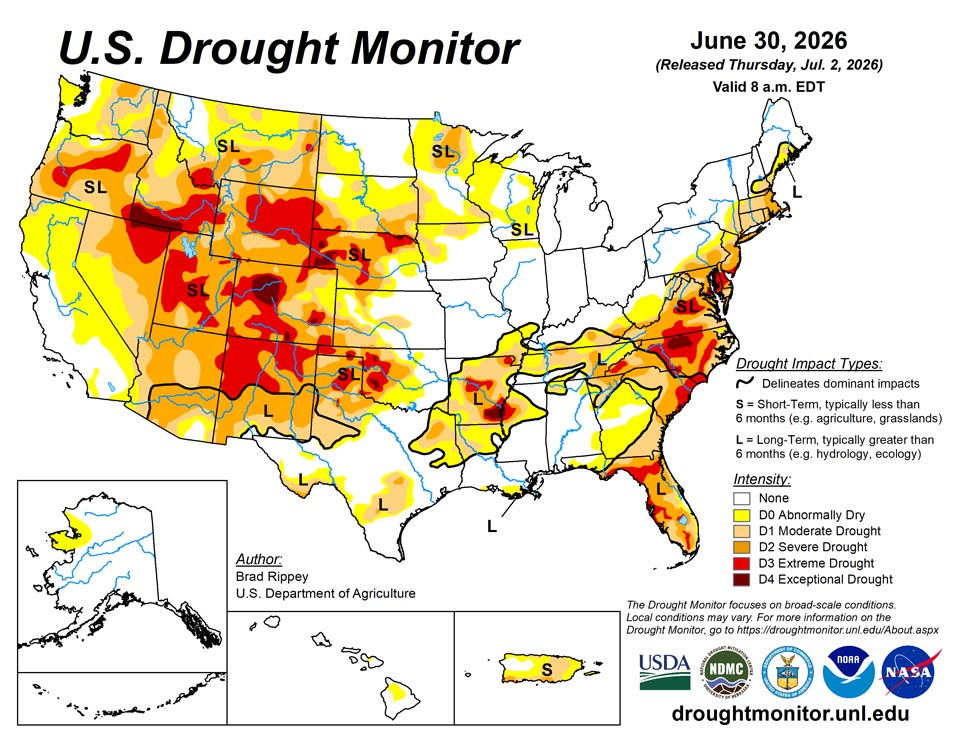
Source: National Drought Mitigation Center
