


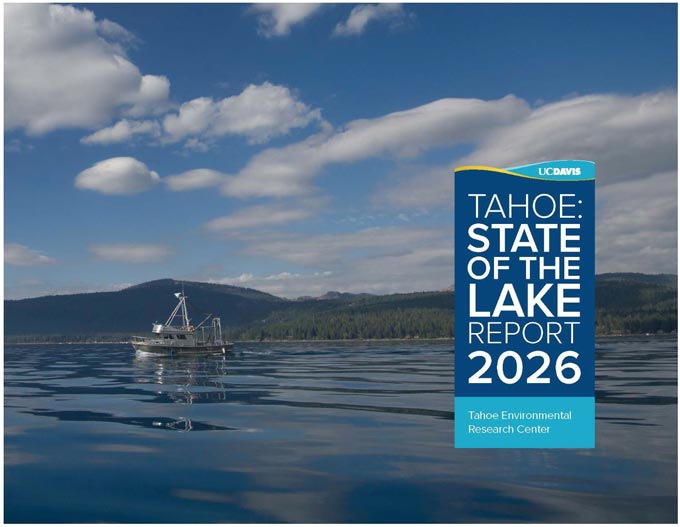
State of the Lake 2026: Fifty Years of Discoveries and Looking Toward the Future
July 17, 2026 - By Kat Kerlin - For nearly 60 years, UC Davis has monitored Lake Tahoe, creating one of the world's longest records of environmental change. This year's State of the Lake Report is especially meaningful as we celebrate the 50th anniversary of the Research Vessel John LeConte, which has supported generations of scientific discovery. The report highlights both encouraging signs of progress and the emerging challenges shaping Tahoe's future.
Full Report
Climate Change Continues to Shape the Lake
Lake Tahoe's climate continues to warm. Air temperatures are rising, fewer winter days remain below freezing, and spring snowmelt is arriving earlier. These changes influence lake mixing, water temperatures, and the movement of nutrients throughout the ecosystem. While 2025 saw near-average precipitation and a healthy snowpack, the long-term warming trend is evident.
Water Clarity Holds Steady
Lake Tahoe's famed clarity averaged 69.2 feet in 2025, continuing the encouraging plateau that has followed decades of restoration efforts. However, scientists observed unusually high concentrations of tiny, suspended particles in the summer months that may be limiting clarity, despite relatively low inputs from streams and wildfire smoke. Understanding these particles is now a major focus of ongoing research.
Evidence suggests that microscopic algae, picoplankton, and the tiny diatom Cyclotella may play a much larger role in determining water clarity than previously understood. Understanding these particles has become one of TERC's highest research priorities.
Watching the Lake in New Ways
TERC scientists continue to expand their study of Lake Tahoe with new technologies.
Building on decades of continuous monitoring, researchers are deploying new technologies to study the smallest particles and organisms in the lake, helping answer fundamental questions about clarity, climate change, wildfire impacts, and ecosystem health. These advances will guide future restoration and management efforts.
A new drone with advanced imaging technology is transforming how researchers monitor algae along the lake's 75-mile shoreline, providing a much more complete picture than traditional field sampling alone.
Expanding Research on Wildfire Impacts
Atmospheric nutrients from wildfire smoke returned to near historical averages in 2025 following the elevated levels observed after the Caldor Fire. New analyses also show that smoke from distant wildfires regularly reaches the Tahoe Basin, reinforcing the need to understand how regional fires affect the lake. A new collaboration with atmospheric researchers at UC Davis aims to understand how smoke from fires, near or far, is affecting Lake Tahoe's freshwater ecosystem, starting with its tiniest inhabitants at the base of the food web.

Science only matters if it reaches people
Science is most powerful when it's shared. In 2025, TERC engaged nearly 8,000 visitors through educational programs, public lectures, tours, and interactive exhibits, while reaching more than 19,000 additional people through newsletters, social media, and other communication platforms. Together, these efforts are building a broader community of informed stewards committed to protecting Lake Tahoe.
Looking Ahead
The 2026 State of the Lake Report demonstrates that decades of science and restoration have made a difference, while underscoring the challenges posed by climate change, wildfire, and emerging environmental pressures. With one of the world's longest environmental records and an expanding portfolio of cutting-edge research, UC Davis and its partners are helping ensure that decisions about Lake Tahoe's future are grounded in the best available science.
Source: UC Davis
