


The ATF’s proposed rule would remove guardrails against the use of the stabilizing brace, which has been utilized by mass shooters to kill dozens in recent years.
August 6, 2026 - Washington, D.C. – U.S. Senator Adam Schiff (D-Calif.) is leading an effort urging the Bureau of Alcohol, 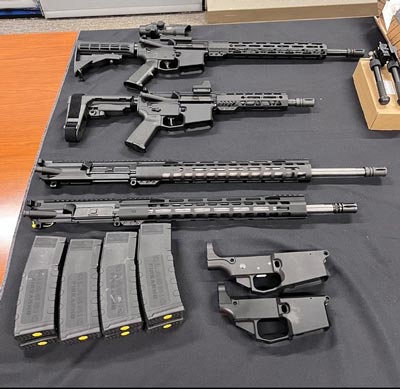 Tobacco, Firearms and Explosives (ATF) to drop its plans to amend federal firearm rules and remove the guardrails currently in place combatting the improper use and classification of stabilizing braces, a device used in several mass shootings that can turn a semiautomatic pistol into a short-barreled rifle – making it easier to control and more effective at inflicting harm. Current law treats firearms equipped with certain stabilizing braces as short-barreled rifles, reflecting the increased lethality of a gun using the enhancement.
Photo: Guns without bump stocks
Schiff and his colleagues argue that ATF’s proposal to remove the criteria for that classification poses a risk to the American public and allows the gun industry to profit off the sale of stabilizing braces at the expense of public safety.
“Under ATF’s newly proposed rule, firearms equipped with stabilizing braces would no longer be treated as short-barreled rifles even though such firearms look, are used, and shoot just like short-barreled rifles. This proposed rule would reopen the door to the same uncertainty and inconsistency – creating serious risks to public safety,” the Senators wrote.
Their effort cites several recent high-profile shootings where stabilizing braces were used, including the 2022 shooting at Club Q in Colorado Springs and the 2023 shooting at Covenant School in Nashville, to emphasize the need for a clear regulatory framework to determine when firearms equipped with stabilizing braces should be classified as short-barreled rifles.
Further, the Senators point out that the ATF previously documented the heightened risks posed by stabilizing braces.
“In ATF’s own words, ‘Should a person choose to circumvent the NFA by effectively making unregistered ‘short-barreled rifles’ by attaching an accessory such as a ‘stabilizing brace,’ these dangerous, easily concealed weapons would pose an increased public safety problem.’ ATF continues, ‘Removing from the regulations the criteria for assessing whether a given stabilizing brace/accessory-firearm configuration qualifies as an NFA firearm increases the public risk,’” the Senators continued.
“We strongly urge ATF to withdraw this proposed rule and retain the factoring criteria for firearms with attached stabilizing braces. Doing so will preserve the consistent enforcement of the NFA, support law enforcement’s ability to identify and trace dangerous easily concealed weapons, and help ensure that individuals seeking firearms functionally equivalent to short-barreled rifles – including those seeking to commit acts of mass violence – cannot evade longstanding safeguards established by Congress,” the Senators concluded.
Schiff’s letter was signed by U.S. Senators Chris Murphy (D-Conn.), Andy Kim (D-N.J.), Dick Durbin (D-Ill.), Kirsten Gillibrand (D-N.Y.), and Richard Blumenthal (D-Conn.).
This is the third such effort recently led by Schiff opposing ATF’s proposed rollbacks of commonsense firearm regulations. Schiff and others opposed ATF’s proposals to weaken marking requirements for NFA firearms and to eliminate a longstanding requirement that those seeking to make or distribute NFA firearms notify their Chief Law Enforcement Officer (CLEO).
The full text of the letter can be found here and below.
The Department of Justice (DOJ) and Bureau of Alcohol, Tobacco, Firearms and Explosives (ATF) play a critical role in protecting American communities from violent crime involving the illegal use of firearms. However, in April, the ATF announced over 30 new rules that will make significant changes to federal firearms regulations, threatening decades of progress in advancing public safety, supporting law enforcement, and ensuring the consistent administration of our federal firearms laws. One of these proposed rules, “Removing Factoring Criteria for Firearms with Attached ‘Stabilizing Braces’” (RIN 1140-AA98, Docket No. ATF-2026-0335) , would rescind the agency’s 2023 regulation establishing the framework used to determine when firearms equipped with stabilizing braces are properly classified as short-barreled rifles under the National Firearms Act (NFA). We urge the ATF to carefully consider the significant legal, public safety, and practical consequences of this proposal and retain the objective criteria for classifying firearms equipped with stabilizing braces.
The 2023 rule established a series of factors for determining whether a firearm fitted with a stabilizing brace is designed, made, and intended to be fired from the shoulder, thereby subjecting it to the existing statutory and regulatory requirements applicable to short-barreled rifles under the NFA, including application, registration, identification, and recordkeeping requirements. The rule was adopted in response to concerns that stabilizing braces were being made, sold, and used to circumvent longstanding restrictions on short-barreled rifles and followed several high-profile shootings during which stabilizing braces were used. These incidents include:
- The 2019 mass shooting in Dayton, Ohio, where the shooter used an Anderson Manufacturing AR-15-style pistol equipped with a stabilizing brace and killed nine people and injured 17 others.
- The 2021 shooting at a King Soopers grocery store in Boulder, Colorado, where the shooter used a Ruger AR-556 pistol equipped with a stabilizing brace, killing ten people, including a law enforcement officer.
- The 2022 shooting at Club Q in Colorado Springs, Colorado, where the shooter used an unserialized privately made firearm equipped with a stabilizing brace, killing five people and injuring 19 others.
- The 2023 Covenant School shooting in Nashville, Tennessee where three children and three staff members were killed.
- The 2025 Midtown Manhattan mass shooting where four were killed, including an off-duty New York Police Department Officer.
These and other incidents underscore the increasing use of brace-equipped firearms in violent crime, likely due in large part to the concealability of the weapons, and reinforce the need for a clear, objective regulatory framework to determine when such firearms need to be properly classified as short-barreled rifles under federal law.
Congress enacted the NFA in 1934 to regulate particularly dangerous weapons, including short-barreled rifles, short-barreled shotguns, machine guns, silencers, and destructive devices. Congress determined that these firearms warranted heightened regulation because of the ease with which they could be concealed and their potential use in violent crime. Nearly a century later, these weapons continue to pose significant crime problems when they are unregistered or unregulated, evidenced by the several high-profile shootings noted above. Even the Trump DOJ has acknowledged Congress’s intent behind the NFA, describing the foundational federal firearms law as “a legislative effort animated by the emergence of armed crime as a major national problem” that sought to “[target] particularly dangerous and easily concealable weapons that could be used readily and efficiently by criminals.” The NFA’s heightened regulatory framework helps ensure accountability for these firearms and provides law enforcement with essential tools to trace these firearms when recovered during criminal investigations.
Prior to the 2023 rule, ATF issued a series of classification letters and guidance documents addressing firearms equipped with stabilizing braces, resulting in considerable uncertainty regarding how the NFA applied to these firearms. With this uncertainty, the gun industry began to make and sell more stabilizing braces to circumvent NFA restrictions and regulations. The 2023 stabilizing brace rule sought to replace this inconsistent, case-by-case approach with objective criteria for determining whether a firearm equipped with a stabilizing brace is designed, made, and intended to be fired from the shoulder and therefore falls within the statutory definition of a short-barreled rifle. By replacing inconsistent case-by-case determinations with objective regulatory criteria, the 2023 rule promoted greater consistency, predictability, and transparency in the administration of the NFA, and, in turn, did what the NFA was intended to do: protect the public from violent crime.
ATF now seeks to rescind the 2023 rule altogether. Under ATF’s newly proposed rule, firearms equipped with stabilizing braces would no longer be treated as short-barreled rifles even though such firearms look, are used, and shoot just like short-barreled rifles. This proposed rule would reopen the door to the same uncertainty and inconsistency – creating serious risks to public safety. In ATF’s own words, “Should a person choose to circumvent the NFA by effectively making unregistered ‘short-barreled rifles’ by attaching an accessory such as a ‘stabilizing brace,’ these dangerous, easily concealed weapons would pose an increased public safety problem.” ATF continues, “Removing from the regulations the criteria for assessing whether a given stabilizing brace/accessory-firearm configuration qualifies as an NFA firearm increases the public risk.”
In addition to serious public safety concerns, this rule creates more regulatory uncertainty for firearm owners, manufacturers, dealers, and law enforcement agencies. Rescinding an existing framework would also eliminate the objective standards for evaluating brace-equipped firearms. Further, eliminating these standards risks inconsistent enforcement, increased litigation, and uncertainty regarding the scope of existing statutory definitions. This uncertainty benefits neither responsible firearm owners seeking clear guidance, nor law enforcement agencies charged with enforcing federal firearm laws.
We strongly urge ATF to withdraw this proposed rule and retain the factoring criteria for firearms with attached stabilizing braces. Doing so will preserve the consistent enforcement of the NFA, support law enforcement’s ability to identify and trace dangerous easily concealed weapons, and help ensure that individuals seeking firearms functionally equivalent to short-barreled rifles – including those seeking to commit acts of mass violence – cannot evade longstanding safeguards established by Congress.
Source: Senator Adam Schiff
