


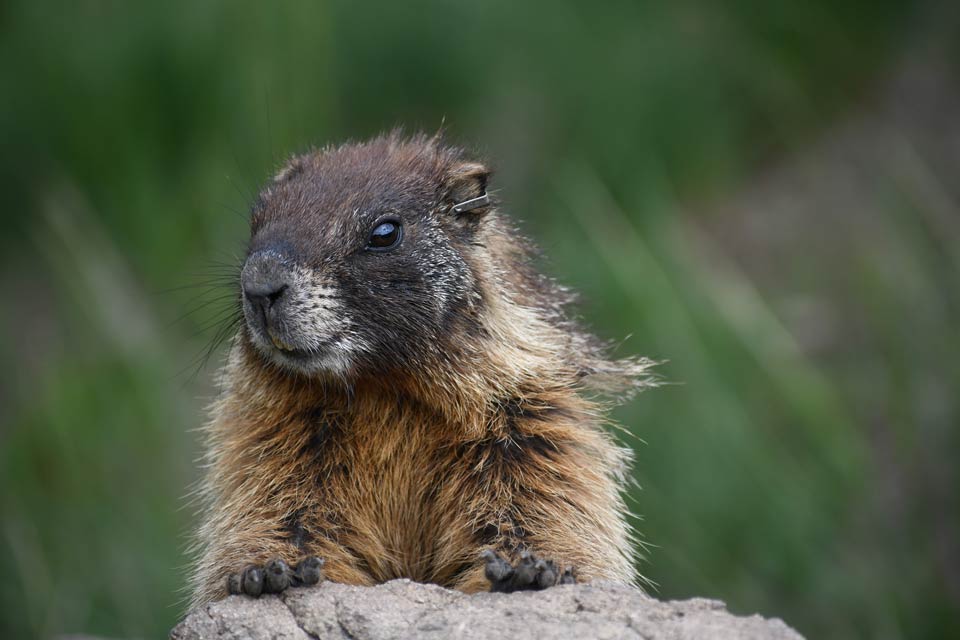
 The Secret to Longevity? Ask a Yellow-Bellied Marmot - UCLA-Led Study Shows That Aging Slows to a Crawl When the Animals Hibernate
During their time hibernating, marmots’ breathing slows, they burn a single gram of fat per day, and their body temperature plummets to the point that “they feel like fuzzy, cold rocks.” Credit: Daniel Blumstein/UCLA
Voting runs from Aug. 24–28, with the winner crowned Aug. 29
Key takeaways
- The Rocky Mountain Biological Laboratory Marmot Project will host its first-ever Fat Marmot Week from Aug. 24–29.
- Fat Marmot Week is a lighthearted, tournament-style event that highlights the remarkable transformation yellow-bellied marmots undergo each summer as they double their body size in preparation for winter hibernation.
- Yellow-bellied marmots turn their body temperature and heart rate down to practically nothing during the winter and do not awaken till spring.
August 21, 2026 - By Holly Ober - UCLA professor Dan Blumstein and his lab’s efforts to raise funds for research by putting the marmots he studies on OnlyFans isn’t the only reason the roly-poly rodents are the “it” squirrels of the summer. Starting Aug. 24, the public can vote for their favorite furballs as they fatten up for winter hibernation.
The Rocky Mountain Biological Laboratory (RMBL) Marmot Project will host its first-ever Fat Marmot Week Aug. 24–29, inviting the public to celebrate one of the Rocky Mountains’ most charismatic residents while learning the science behind their annual weight gain. Run by UCLA graduate students Katie Adler and Emily Renkey, Fat Marmot Week is a lighthearted, tournament-style event that highlights the remarkable transformation yellow-bellied marmots undergo each summer as they feed almost constantly on grasses and wildflowers in preparation for about five months of hibernation.
Video
View an audio descriptive version of the video.
Unlike Katmai National Park’s famous grizzlies, marmots are true hibernators. They’ll plug their burrows and hibernate when their food sources dry up and it gets too cold — and won’t emerge from their burrows till the snow is starting to melt, so they need to plump up to survive. Fat Marmot Week is an opportunity to learn about these cute little furries and how climate change is challenging their survival.
“It’s fun to root for the chunkiest marmot, but behind the fun and games is a deathly serious competition against nature to pile on fat to survive the long, cold winter. And these days, with less predictable weather and wild fluctuations in snowfall, survival is not guaranteed,” said Blumstein, professor of ecology and evolutionary biology at UCLA and co-director (with University of Ottawa professor Julien Martin) of the RMBL Marmot Project. “Importantly, marmots give us a window on the health of high-alpine ecosystems.”
No matter how fat bears get, they don’t truly hibernate. Bears enter what’s known as torpor, which is a sleeplike state in which their body temperature remains fairly high, and they wake occasionally when roused. North America’s plushest true hibernators are much smaller — and just as cute.
Yellow-bellied marmots, a large ground squirrel, are loaf-sized rodents that live in burrows and are a familiar sight to backpackers and travelers across the Intermountain West. Marmots spend the summer gorging on grasses, roughly doubling their body size with fat that will provide the calories they need to survive winter hibernation. They curl up in their burrows, turn their body temperature and metabolism down to almost nothing and slow their heart rate to just a few beats per minute. Almost nothing awakens them from this state until spring.
Established in 1962 at RMBL’s campus outside Crested Butte, Colorado, the RMBL Marmot Project is one of the world’s longest-running studies of individually marked wild mammals. Decades of research have helped scientists better understand yellow-bellied marmots’ behavior, social relationships and survival in alpine ecosystems.
Voting opens Aug. 24 at sites.google.com/view/fatmarmotweek, where participants can vote for the marmot they think best exemplifies healthy hibernation preparation. Final-round voting takes place Aug. 28, and the chunky champion will be crowned Aug. 29. Follow @rocky_mountain_bio_lab and @rmblmarmotproject on Instagram for updates.
Source: UCLA
