


2026 Subaru Outback credit: Subaru
KEY TAKEAWAYS
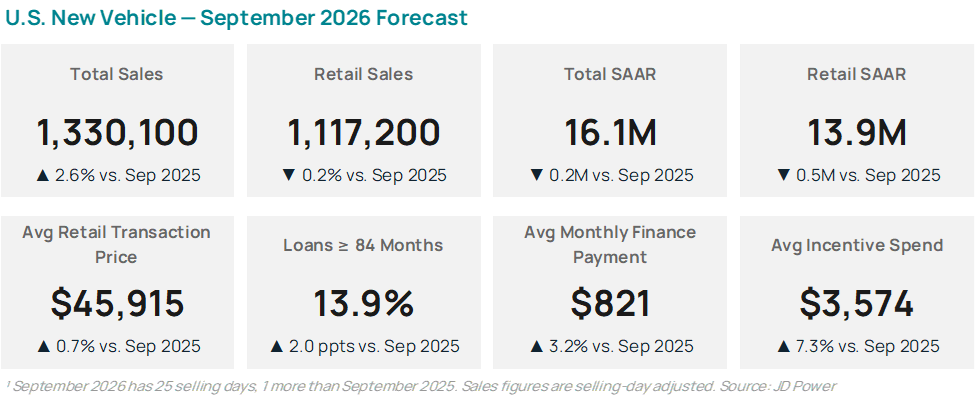
- September new-vehicle total sales on track for 2.6% increase year over year with a SAAR of 16.1M
- Consumer expenditure on new vehicles in September is projected to increase 6.6% year over year to $48.7 billion
- Average monthly payments expected to rise 3.2% to a September record of $821, while interest rates projected to drop 4 basis points to 6.66%, the lowest September level since 2022
The Total Sales Forecast
September 25, 2026 - Total new-vehicle sales for September 2026, including retail and non-retail transactions, are projected to reach 1,330,100, a 2.6% increase year over year, according to a joint forecast from JD Power and GlobalData. Reporting the same numbers without adjusting for the number of selling days translates to an increase of 6.9% from September 2025. The seasonally adjusted annualized rate (SAAR) for total new-vehicle sales is expected to be 16.1 million units, down 0.2 million units from 2025.
New vehicle total sales for Q3 2026 are projected to reach 4,090,400 units, a 0.5% decrease from Q3 2025 on the same number of selling days.
The Retail Sales Forecast
New-vehicle retail sales for September 2026 are projected to reach 1,117,200, a 0.2% decrease from September 2025. Reporting the same numbers without adjusting for the number of selling days translates to an increase of 4.0% from 2025. The SAAR for retail new-vehicle sales is expected to be 13.9 million units, down 0.5 million units from September 2025.
Retail new-vehicle sales in Q3 2026 are projected to reach 3,469,200 units, a decrease of 1.8% from Q3 2025 on the same number of selling days.
Thomas King, president of OEM solutions at JD Power:
“September results continue to demonstrate strong demand for new vehicles, with the annualized total selling rate reaching 16.1 million units. However, as has been the case for several months, year-over-year comparisons are complicated by quirks in the industry sales reporting calendar and the ending of Federal EV credits on September 30, 2025.
“Last year, the Labor Day holiday, which is one of the busiest shopping periods of the year, fell into the August sales reporting month. This year Labor Day fell into September, making a favorable comparison to a year ago.
“Conversely, September sales a year ago were inflated by the announcement that federal EV credits of up to $7,500 would expire on September 30, 2025, prompting many EV intenders to accelerate purchases into September 2025 that would otherwise have occurred later in the year.
“In totality, these dynamics are expected to result in 1,117,200 retail sales this month, a decrease of 0.2% on a selling day adjusted basis, but an increase of 4.0% on a non-selling day adjusted basis since September has an extra selling day this year.
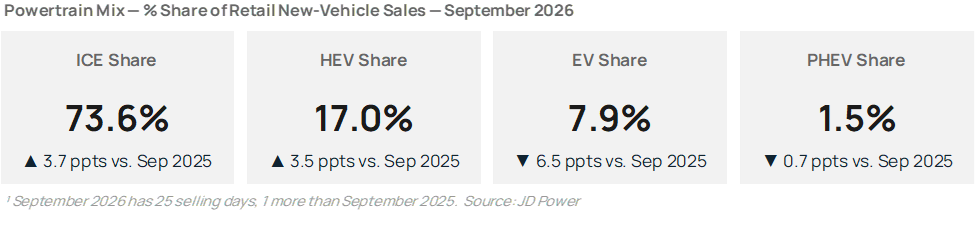
“EV share of retail sales has fallen 6.5 percentage points to 7.9% following the elimination of federal EV credits. However, elevated fuel prices and increased availability of vehicles with hybrid powertrains are driving a shift in powertrain sales mix. Hybrid share of retail sales is expected to reach 17.0%, up 3.5 percentage points from last year, despite ongoing tight inventory for some of the best-selling hybrid models on the market.
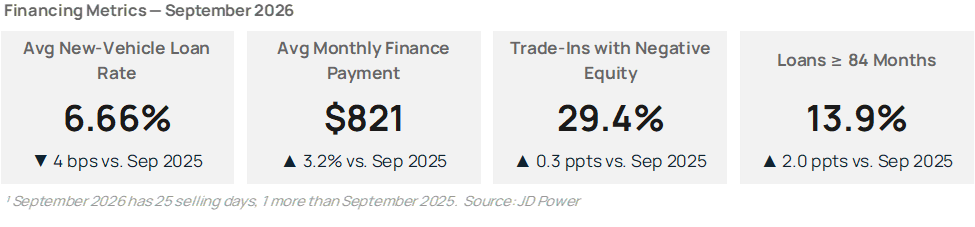
“Regarding affordability, the cost of financing a new vehicle has eased again, but it may come under pressure in the coming months due to recent policy changes. The average interest rate on new-vehicle loans is expected to fall 4 basis points to 6.66%, the lowest September reading since 2022. However, the lower cost of financing in September is not enough to offset the structural affordability pressures facing buyers. The average transaction price of a new vehicle has increased to $45,915, up 0.7% from a year ago, while average monthly finance payments have climbed 3.2% to $821, the highest ever for the month of September.
“To manage monthly payments, consumers are using longer loan terms. A total of 13.9% of loans now have terms of 84 months or longer, up 2.0 percentage points year over year, helping to partially bridge the affordability gap.
“A key driver of the higher monthly payment, despite longer loan terms, is lower trade-in equity. Many buyers returning to showrooms today purchased when prices were at their peak several years ago, when inventory was scarce. This is manifesting itself as more buyers carrying negative equity on their trade-ins. In September, 29.4% of trade-ins had negative equity, up 0.3 percentage points from a year ago.
“Subprime penetration remains elevated from last year, with the mix rising 2.2 percentage points from September 2025 to 11.2% this month, in part because many buyers with strong credit and the ability to accelerate their purchases did so last year.
“Manufacturers are leaning harder into discounts to keep buyers in the market. Average incentive spending per vehicle is trending towards $3,574, a 7.3% increase from a year ago. Incentives as a percentage of MSRP are expected to hit 6.9% in September, up 0.4 percentage points from September 2025.
“The divergence in manufacturer incentive strategies by powertrain continues to be evident in September. Incentive spending on traditional internal combustion engine and hybrid vehicles is expected to increase $797 per unit year over year, up 31.6% to $3,319 in September 2026. Meanwhile, EV incentives moved in the opposite direction, with a forecasted decline of $2,450 per unit or 21.7% to $8,829, contributing to the 6.5 percentage point decline in EV share of new-vehicle sales compared to last year.
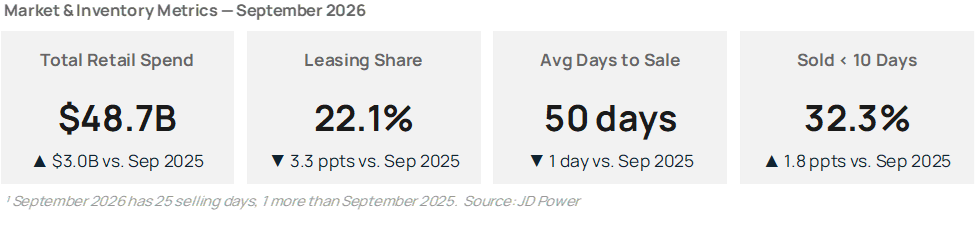
“Regarding the value of new vehicles being purchased, the increase in retail sales volume combined with the increase in transaction prices means that total retail consumer expenditure is projected to increase 6.6% to $48.7 billion, an increase of $3.0 billion from September 2025.”
Global Sales Outlook
David Oakley, manager, Americas vehicle sales forecasts at GlobalData:
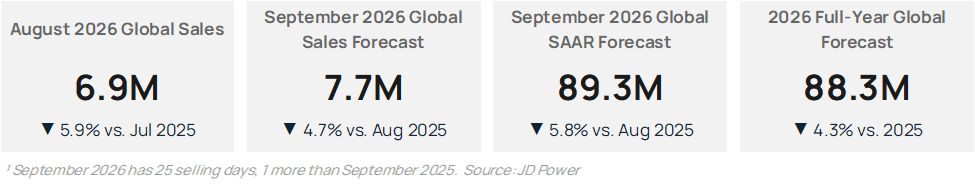
“August global light-vehicle sales are estimated to have declined 5.9% year over year to 6.9 million units. Continuing a recurring theme from recent months, sales slumped by a large margin year over year in China, meaning that global sales were never likely to rise, given the size of the Chinese market. The global selling rate for August was estimated at 91.5 million units, up from 90.0 million units in July.
“The Chinese market saw a 24.5% year-over-year decrease in sales in August, excluding any vehicles intended for export. Although selling rates have shown signs of levelling out in recent months, year-over-year comparisons are still well down. The removal of trade-in subsidies, combined with the weak state of local government finances, means that the market is now more reliant on natural demand. In contrast, the Indian market continued to surge in August, with sales estimated to have increased 34.6% year over year. The reduction of the goods and services tax (GST) rate is still boosting year-over-year metrics, while high consumer confidence and positive financing conditions are also contributing to a strong market. Elsewhere, Western Europe, South America and Japan delivered gains, offset to some extent by falling sales in North America and Korea.
“September sales are expected to decline 4.7% from September 2025 to 7.7 million units. This would translate to a selling rate of 89.3 million units, down by 5.8% year over year. Once again, China is expected to be a drag on global volumes, while India is likely to see growth. European sales are forecast to be relatively flat year over year, while volumes are likely to decline in the Middle East, due in part to regional instability.
“Our forecast for total global sales in 2026 has been cut to 88.3 million units, compared to 89.7 million units a month ago. This forecast would represent a 4.3% year-over-year decline, with no major change in dynamics in the Chinese market expected until 2027. The conflict in the Middle East is becoming ever more protracted and complex, meaning that the prospects of meaningful declines in energy prices are becoming more remote. This presents downside risks to global auto sales forecasts, as inflation increases, and central banks respond by hiking interest rates.”
About JD Power
JD Power is a proven leader in business-critical data and intelligence to drive auto-related decisions with confidence and clarity. By leveraging unmatched proprietary data, advanced analytics and deep industry expertise, JD Power fuels original equipment manufacturers, retailers, lenders, insurers and partners to enhance their performance.
Since 1968, JD Power has delivered incisive guidance and intelligence about customer interactions with brands and products. To learn more about the company’s business offerings, visit JDPower.com.
About GlobalData: https://www.globaldata.com/
Source: JD Power
