


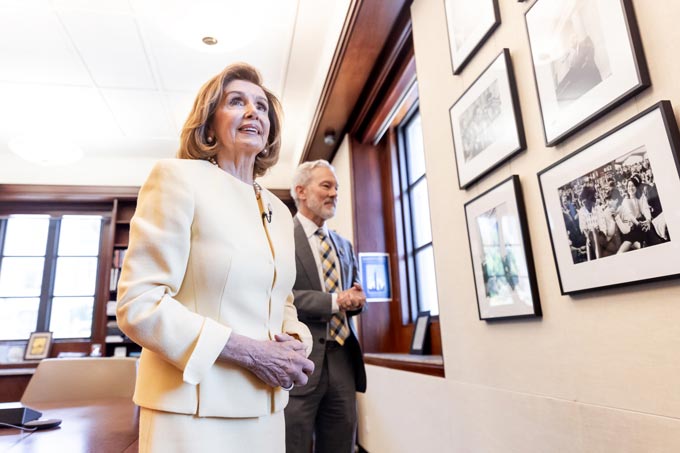
Former House Speaker Nancy Pelosi and UC Berkeley are joining forces to launch the Nancy Pelosi Institute for Representative Democracy, a new nonpartisan institute dedicated to strengthening American democracy. Launching in January 2027, the institute will bring together faculty, students and visiting leaders to study democracy's toughest challenges, from polarization to the future of AI, and to prepare the next generation of civic leaders. Brittany Hosea-Small/UC Berkeley
The nonpartisan academic institute in the political science department will become a hub for research, teaching and civic engagement
July 6, 2026 - By Strategic Communications - UC Berkeley is joining forces with Nancy Pelosi, the first female speaker of the U.S. House of Representatives, to launch a new, nonpartisan institute dedicated to strengthening American democracy and advancing solutions to the country’s most pressing challenges.
The Nancy Pelosi Institute for Representative Democracy, or NPI, will be a hub for research, teaching and civic engagement rooted in a shared commitment to advancing the public good. Through faculty research initiatives, undergraduate courses and a visiting fellows program, the institute will explore what impedes progress and how best to solve political problems, from polarization to the future of artificial intelligence.
Chancellor Rich Lyons said the institute aligns with Berkeley’s commitment to fostering civil discourse, advancing democracy and preparing students to lead with integrity.
“The purpose and impact of the NPI will be defined and strengthened by Berkeley’s ability to bring together world-class faculty and extraordinary students and by our commitment, as the country’s preeminent public university, to advancing the greater good,” Lyons said. “We intend to do more than simply study democracy; we are building this institute to strengthen it.”
With plans to support hundreds of students annually, the NPI will launch in January in the Charles and Louise Travers Department of Political Science. Pelosi, the first Californian to serve as House speaker, is slated to co-teach a course about Congress.
“The work of democracy is never finished, and securing its future is our greatest calling,” Pelosi said. “UC Berkeley has a long, proud history of challenging the status quo and producing leaders who run toward the greatest challenges of our time. I am honored to partner with this exceptional community of scholars and students so we can equip the next generation with the tools they need to strengthen our democratic institutions and forge a future that serves the public good.”
We intend to do more than simply study democracy; we are building this institute to strengthen it.
UC Berkeley Chancellor Rich Lyons
The institute’s work will focus on four pillars: strengthening America’s democratic institutions; overcoming America’s greatest challenges for our society, economy and planet; promoting human rights and civil rights at home and abroad; and ensuring political leadership that represents the full spectrum of perspectives and backgrounds in California and the country.
Basing the institute at Berkeley means it will serve a student body where one-quarter of undergraduates are the first in their family to attend college and 27% receive federal Pell Grants, which are reserved for undergraduate students who display exceptional financial need. That, coupled with the fact that Berkeley is a leading source of elected officials and government leaders, means the institute will give future leaders from every background the kind of experience once reserved for those in the Ivy League.

Brittany Hosea-Small/UC Berkeley
“The study of political science is most impactful when it bridges the gap between academic research and real-world governance,” said Scott Straus, chair of the Travers Department of Political Science. “This institute will provide our students and faculty with unprecedented opportunities to engage directly with the mechanics of leadership and move ideas from the classroom into the real world, ensuring that our research directly informs the leaders and policymakers who are working for a better tomorrow across the political spectrum.”
The institute has received more than $35 million in philanthropic commitments, primarily earmarked for a permanent endowment. Officials set a $50 million fundraising goal to solidify the institute as a national leader in research and fellowships. Efforts are underway to build endowed resources for years to come.
“This is a watershed moment for our university — and a fantastic opportunity for our alumni and friends to join us in shaping it. We envision the Pelosi Institute encompassing a range of bold centers and initiatives, ranging from a Center for the U.S. House of Representatives to a Global Dignity Lab to an AI & Democratic Innovation Initiative to a Center for the Study of Gender and Politics. There are lots of possibilities for people to support things they’re passionate about,” Straus said. “For anyone who’s curious about how they can help the Pelosi Institute flourish through their giving, we would welcome them to reach out to us.”
Next spring, the Bancroft Library will host a public exhibit about Pelosi’s life and experience in the U.S. House of Representatives. The institute will then become home to an exhibit chronicling Pelosi’s career.
“There could be no better place than Berkeley,” said Raka Ray, dean of Berkeley’s Division of Social Sciences. “This institute represents an incredible opportunity to create an academic center with national and global impact at a university that has long served as a pipeline for civic leadership.”
